
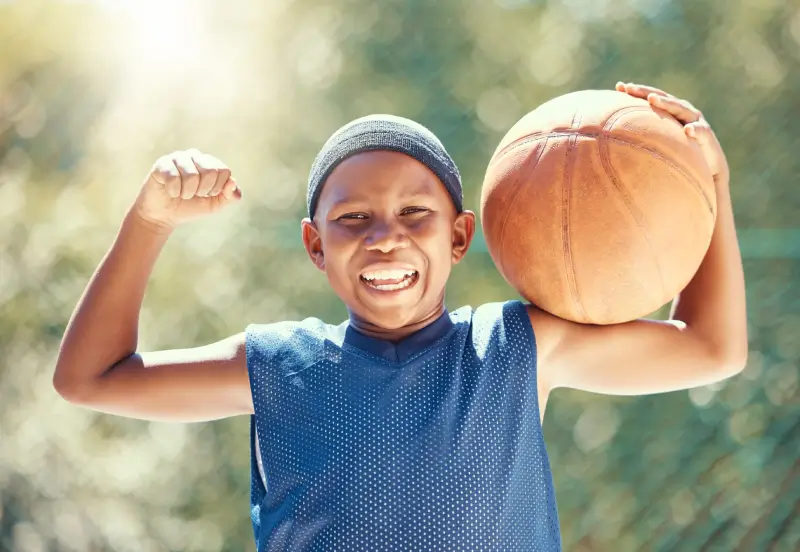
Here’s something most parents and coaches completely miss: The biggest difference between players who reach their potential and those who fall short isn’t physical ability. It’s mental toughness.
After forty years of coaching and teaching, I’ve watched physically gifted athletes flame out while less talented players became stars. The difference? What happens between their ears.
Youth basketball programs spend countless hours on shooting drills, defensive footwork, and conditioning. That’s all necessary. But they neglect the most important aspect of player development: teaching kids to think like champions. The mental game separates good players from great ones, and it’s a skill that must be taught intentionally, not left to chance.
Why Mental Training Is Often Neglected
Most coaches avoid mental training because it’s harder to measure than free throw percentages. You can’t film mental toughness on video or track it on a stat sheet. It requires patience, consistency, and a willingness to address topics that many youth coaches aren’t comfortable discussing.
Parents make the same mistake. They focus on what they can see: their child’s playing time, scoring average, and team’s win-loss record. They miss the internal battles their child faces every time they step on the court:
- The fear of failure
- The pressure to perform
- The doubt that creeps in after mistakes
These mental challenges matter far more than any physical limitation.
Here’s the truth: Physical skills plateau. Your child will eventually reach the limits of their athletic ability. But mental toughness keeps growing throughout their entire career. The mental habits they build now, in youth basketball, will serve them through high school, college, and far beyond the game itself.
The Most Important Conversations You Have Are with Yourself
I teach every player who comes through The Kane Academy this principle: Learn to talk to yourself rather than listen to yourself.
This concept changes everything.
When you listen to yourself, you hear all the negative thoughts that naturally arise during competition: “I can’t make a shot today,” “That player is too good for me,” “The coach doesn’t like me,” “I’m going to mess this up.” These thoughts are automatic, and if you just listen to them, they control your performance.
When you talk to yourself, you take control of the narrative. You replace negative thoughts with productive ones: “I’ve made this shot a thousand times in practice,” “I’m going to give my best effort on every possession,” “I trust my training,” “Next play.” This isn’t about lying to yourself or fake positivity. It’s about directing your mind toward what actually helps performance.
Your child needs to understand this distinction. They need specific phrases they can use when doubt creeps in. They need practice replacing destructive thoughts with constructive ones. This skill doesn’t develop accidentally. You have to teach it, practice it, and reinforce it constantly.
Never Let the Pressure Exceed the Pleasure
This is the foundation of everything we do at The Kane Academy. Basketball should be challenging, demanding, and push your child beyond their comfort zone. But the moment pressure overwhelms the joy of playing, performance collapses and development stops.
I’ve watched too many talented young athletes destroyed by excessive pressure. They stop playing loose and start playing tight. They stop being creative and start playing safe. They stop enjoying the game and start dreading it. Once that happens, improvement becomes nearly impossible.
The key is finding the right balance. Your child needs enough pressure to stretch them, to make them uncomfortable, to force growth. But they also need to maintain the pleasure that makes basketball fun. When kids enjoy what they’re doing, they practice more, try harder, and handle adversity better. Remove the joy, and you remove their motivation to improve.
As a parent, your job is to monitor this balance. Watch for signs that pressure is exceeding pleasure:
- Reluctance to practice
- Excessive anxiety before games
- Loss of enthusiasm
- Emotional breakdowns after mistakes
When you see these signs, it’s time to reduce pressure and restore joy, not push harder.
The Four Elements of Mental Toughness
I borrowed these principles from Navy SEAL training because they work. The SEALs discovered that mental preparation mattered more than physical ability in determining who succeeded in their program. The same applies to basketball.
- Goal setting: Your child needs to define clear, specific objectives and create actionable plans to achieve them. Not vague wishes like “get better at basketball,” but concrete goals like “make 8 out of 10 free throws” or “execute three perfect defensive slides in every practice.” Goals give them direction and make improvement measurable.
- Visualization: Before they step on the court, your child should mentally rehearse success. They should see themselves making the right play, executing proper technique, and handling pressure situations well. This mental practice prepares their brain for optimal performance. The SEALs found that visualization reduced the shock of combat situations. The same principle helps young athletes handle game pressure.
- Self-talk: We already discussed this, but it’s worth repeating: learning to talk to yourself rather than listen to yourself gives your child control over their internal narrative. They choose what thoughts occupy their mind instead of being controlled by automatic negative thinking.
- Breathing techniques: Proper breathing helps manage stress and maintain composure under pressure. When your child feels anxiety rising, they need a simple breathing technique to calm their nervous system. Deep breath in for four counts, hold for four counts, out for four counts. This physiological response to stress is trainable and incredibly powerful.
Age-Appropriate Mental Skills Development
Mental training needs to match your child’s developmental stage. You can’t expect the same mental sophistication from an eight-year-old that you would from a teenager.
Mental skills for ages 6–10
For ages 6-10, keep it simple. Focus on effort over outcomes. Teach them to recognize their emotions without being controlled by them. Introduce basic positive self-talk like “I can try my best” or “mistakes help me learn.” The goal is to build a foundation of mental resilience through encouragement and normalize struggle.
Mental skills for ages 11–14
For ages 11-14, increase complexity. They can handle more sophisticated goal setting and visualization exercises. They can learn to identify specific negative thought patterns and replace them with productive alternatives. They can begin understanding how their mental state affects their physical performance. This is when mental training becomes more intentional and structured.
Mental skills for ages 15–18
For ages 15-18, mental training should be as rigorous as physical training. They should have specific pre-game mental routines. They should practice pressure situations deliberately. They should understand the connection between mental preparation and competitive success. At this age, the mental game often determines who succeeds at the next level.
Handling Pressure in Game Situations
Game pressure reveals your child’s mental preparation. The player who’s practiced mental skills handles crucial moments differently than the player who’s only practiced physical skills.
- Teach your child to focus on the process, not the outcome: In pressure situations, thinking about results creates anxiety. Thinking about execution creates confidence. Instead of “I need to make this shot or we lose,” they should think “front rim, follow through, trust my shot.” The first creates tension. The second enables performance.
- Teach them to control what they can control: They can’t control whether the shot goes in, whether the ref makes the right call, or whether their opponent plays well. They can control their effort, their attitude, their execution, and their response to adversity. When pressure mounts, narrowing focus to controllable factors reduces anxiety.
- Teach them to embrace pressure moments rather than avoid them: The player who wants the ball with the game on the line is developing a championship mentality. The player who hopes someone else takes the big shot is avoiding the very experiences that build mental toughness. Your child needs to learn that pressure situations are opportunities, not threats.
Building Confidence Through Mental Preparation
Confidence isn’t something you give your child through compliments and encouragement. Real confidence comes from preparation. When your child knows they’ve put in the work, when they’ve practiced the situation, when they trust their training, confidence follows naturally.
Mental preparation builds this foundation. When they’ve visualized making the game-winning shot, they’re not surprised when the opportunity comes. When they’ve practiced positive self-talk, they’re not derailed by negative thoughts. When they’ve worked through pressure situations in practice, they’re ready for pressure situations in games.
False confidence collapses under pressure. Real confidence, built through preparation and proven in competition, grows stronger with each challenge. Your job is to ensure your child is building the real kind through consistent mental training, not the false kind through empty praise.
Coach Kane’s Mental Training Techniques
At The Kane Academy, mental training is integrated into every practice. We don’t separate it from physical training because they’re inseparable in competition.
We create pressure situations in practice deliberately. Players have to execute under fatigue, with time running out, with consequences for mistakes. We’re not trying to make practice miserable. We’re building their capacity to perform when the pressure is highest.
We review mental performance as rigorously as physical performance. After games, we don’t just analyze basketball mistakes. We analyze mental mistakes: Did they maintain positive self-talk? Did they focus on the process? Did they handle adversity productively? These discussions normalize mental training and emphasize its importance.
We teach players to support each other’s mental game. Championship teams don’t just execute plays together. They lift each other up mentally. When a teammate is struggling, championship players provide encouragement, redirect their focus, and help them reset mentally. This collective mental toughness creates unstoppable teams.
What Parents Can Do at Home
You don’t need to be a psychologist to help your child develop mental toughness. You need consistency, attention, and willingness to have important conversations.
- After practices and games, ask about their mental performance, not just their physical performance. “How did you handle that turnover?” is more valuable than “How many points did you score?” These conversations teach them that the mental game matters.
- Help them develop pre-game mental routines. What do they think about before games? What music helps them focus? What visualization exercises work for them? These rituals create mental preparation habits that last a lifetime.
- Model mental toughness in your own life. Your child watches how you handle adversity, pressure, and disappointment. When you demonstrate resilience, positive self-talk, and appropriate responses to stress, you’re teaching mental skills more effectively than any lecture could.
Mental Skills Off the Court
The mental skills your child develops through basketball transfer to every area of life. The student who can manage game pressure can manage test anxiety. The player who maintains positive self-talk on the court can do the same in challenging life situations. The athlete who sets and achieves goals in basketball applies the same process to academic and career objectives.
This is why mental training matters so much in youth basketball. You’re not just building a better basketball player. You’re building a person equipped to handle whatever challenges life presents. The mental toughness they develop now becomes the foundation for success in everything they pursue.
Start Building Mental Toughness in Youth Basketball
Your child will face mental challenges on the basketball court that prepare them for bigger mental challenges in life. The question is whether they face those challenges with tools and training or whether they face them unprepared.
At The Kane Academy, we don’t neglect the mental side of the game. We teach kids to think like champions because thinking like a champion is what creates championship performance. The physical skills get your child noticed. The mental skills get them playing time and create lasting success.
Start teaching mental toughness now. Don’t wait until your child is struggling or until they reach high school. The mental habits they build today in youth basketball will serve them for the rest of their lives. That’s not just good basketball coaching. That’s good parenting.